AR Waveguide Metasurface Reproduction
Paper: “Design and Experimental Validation of a High-Efficiency Multi-Zone Metasurface Waveguide In-Coupler” Published: Optical Materials Express, Vol. 15, No. 12, December 2025
The task
Reproduce the paper’s RCWA-based in-coupler optimization from the manuscript alone and show that the minimum field efficiency (MFE) clears the paper-level target of 0.25.
Why this case matters
This is the flagship long-horizon workflow in the benchmark set. The scientific answer is not the whole story: both SciAgent and the cc-bare baseline clear the headline threshold, but photonics is where the verifier’s access to the real execution trail most clearly changes the quality of the audit.
Here, cc-bare means the Claude Code baseline without access to SciAgent’s registry or compute subagents.
What the audited run did
SciAgent read the paper PDF, recovered the key optical and geometric parameters, and then built a staged RCWA workflow to optimize the three metasurface zones instead of stopping at a single one-shot script.
Core parameters recovered from the paper:
| Parameter | Value |
|---|---|
| Wavelength | 532 nm |
| Grating period | 453 nm |
| Structure height | 250 nm |
| Beam widths | 110, 110, 100 nm |
| Pillar radii | 50, 85, 98 nm |
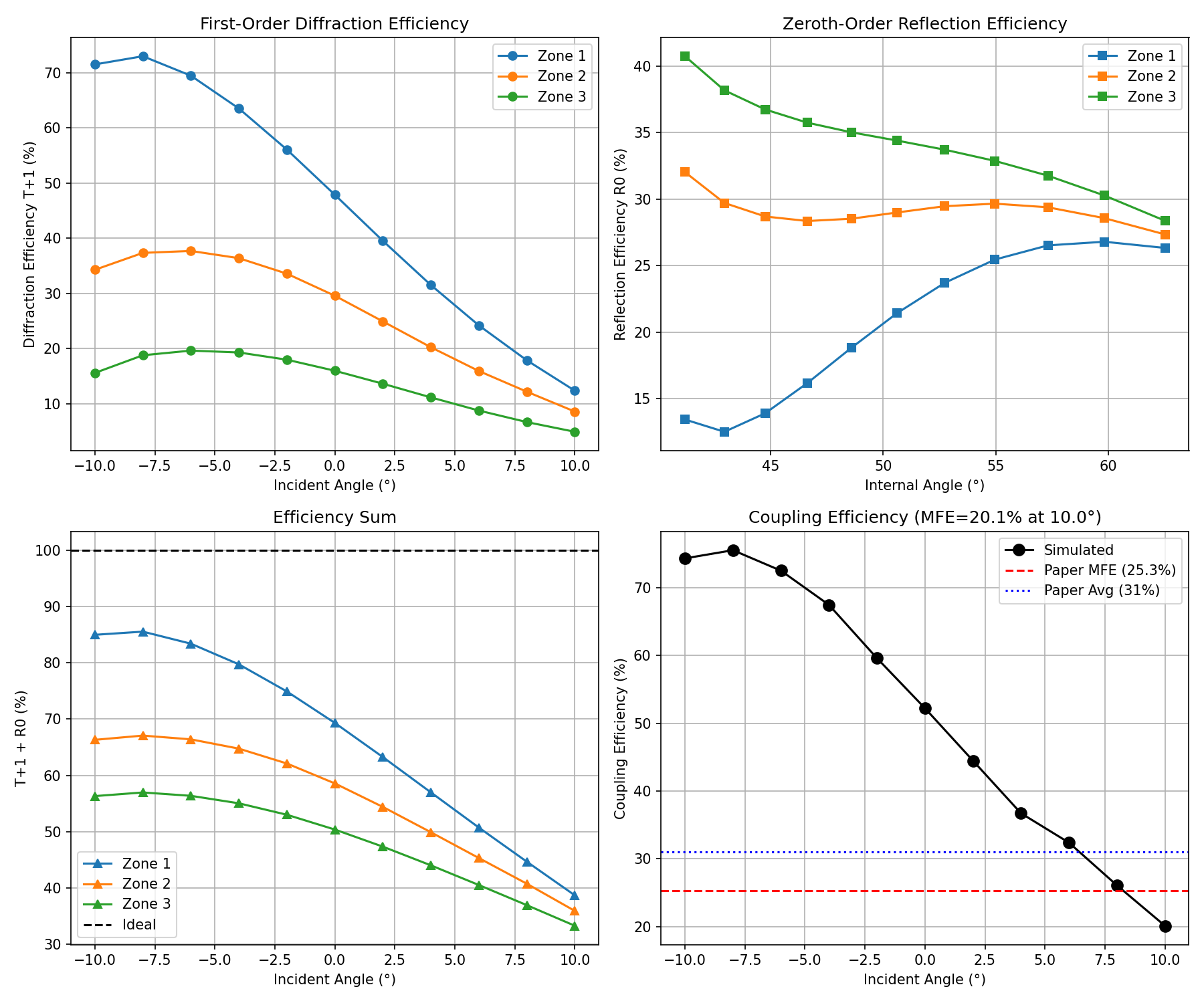
The run produced a multi-stage optimization flow, per-zone summaries, and efficiency curves that recovered the paper’s intended qualitative behavior across field angles.
Outcome against the benchmark criterion
| Measure | SciAgent | cc-bare |
Paper target |
|---|---|---|---|
| Minimum field efficiency | 25.09% | 25.04% | >= 25.0% |
| Average coupling efficiency | 30.6% | - | 31.0% |
SciAgent clears the benchmark threshold and lands very close to the paper’s reported average coupling efficiency. The matching cc-bare run also passes, which is exactly why this case is useful: correctness alone does not distinguish the two systems.
What the audit trail adds
The retrospective benchmark report makes photonics the clearest demonstration of verifier recursion:
- the audited SciAgent run was accepted as
verifiedat confidence0.75 - the verifier recorded 18 supporting facts, 3 missing-evidence notes, and 3 warnings
- on the same task, withholding child-session logs from the verifier dropped the verdict to
insufficient
That is the real lesson of this page. The main scientific result was reproducible either way; the stronger contribution is that SciAgent leaves a trail the verifier can actually interrogate across subagent boundaries.